

Ambition Meets Reality: What the 5th Marine & Offshore Renewables Forum Told Us About the Energy Transition
From Singapore on 10 November 2026, leaders across the marine, offshore, energy and renewable sectors reckoned honestly with a changing narrative. The question has shifted from what the industry wants to achieve, to what can realistically be delivered, financed and supported at scale.

The Industry Has Stopped Asking “What.” Now It Is Asking “How.”
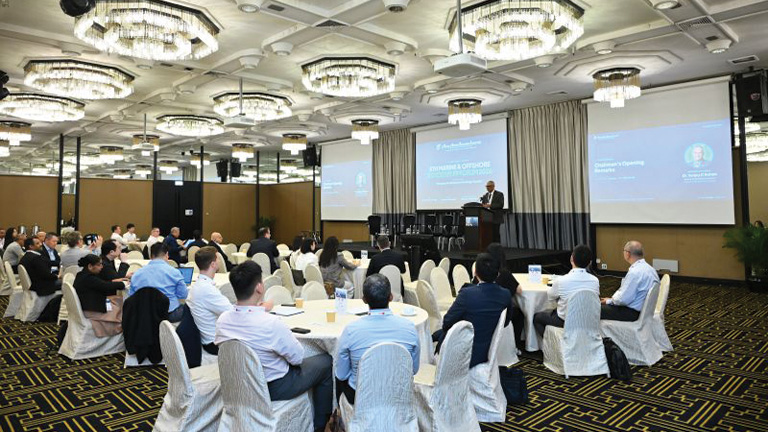
The 5th Marine & Offshore Renewables Forum (M&O 2026) stripped away the ungrounded optimism of early energy transition targets. What filled the Concorde Hotel in Singapore was a reckoning with physical reality: how do we actually build, finance, and connect gigawatts of offshore energy when supply chains are fractured, yards are at capacity, and geopolitical tensions are rewriting investment rules?
The central message across three primary sessions remained unyielding: the energy transition cannot progress through technology or ambition alone. Its momentum ultimately depends on whether policy, capital, people, infrastructure and the wider value chain can move together without breaking down.

Keynote: From Sea to Grid
Professor Aziz Merchant, Executive Vice President of Technology & New Product Development at Seatrium Limited, anchored the technical programme by framing offshore wind not merely as a renewable energy play, but as a multi-decade industrial opportunity.
Global offshore wind capacity is projected to exceed 314 GW by 2035. However, the market requires capabilities extending far beyond turbine technology. Delivering this capacity means building an interconnected system of assets — engineering, fabrication, heavy-lift installation vessels, floating foundations, offshore substations, and subsea transmission networks. Professor Merchant stressed the urgent need to ditch fragmented execution models and build integrated capabilities across the entire journey from generation at sea to transmission into the grid.
Danny Ng of OWC and Matthew Waterhouse of Deloitte expanded on the regional reality. Asia’s energy transition looks fundamentally different from Europe’s. In many Asian markets, renewables are racing to meet rising electricity demand, not just displace coal. Geopolitical disruption has elevated energy security to a primary investment driver — offshore wind and solar now carry a strategic premium because they do not rely on continuously transported fuel. Yet, LNG remains a massive swing factor, threatening to test the cost competitiveness of renewables later in the decade as gas markets loosen and compete for the same marine engineering resources.
Session 1: Policy, Finance & Legal Challenges
The first panel dismantled the illusion that good technology guarantees bankability. Dr. Victor Nian outlined the complex policy backdrop required for ASEAN's transition, noting that regional energy development demands rigid alignment between national priorities, grid planning, and cross-border cooperation to secure firm low-carbon power.
Riccardo Barbiellini brought the focus to the insurability of floating offshore wind. Unlike fixed structures, floating wind merges turbine, foundation, mooring, and dynamic electrical interfaces. Classification and certification are no longer just regulatory checkboxes — they are the foundational proof points that insurers and lenders require to assess and underwrite new technical risks.
Mariko Kawanami mapped how risk travels through a project structure. A supplier disruption leads to a missed weather window; that missed installation window delays commercial operation; and that delay creates intense liquidity and financing pressure. Bankability, she argued, is built through relentless coordination — stress-testing assumptions and allocating risk cleanly before financial close.

Session 2: Manpower Readiness
The second session shifted focus to the people required to execute the transition. Lim Kyik Nam highlighted a daunting metric: global demand for technicians is set to hit approximately 628,000 by 2030, with roughly 40% needing to come from entirely new entrants.
However, the panel challenged the idea that the industry is merely suffering from a numerical shortage. Jason Nangle pointed out that companies consistently handicap themselves by searching for candidates who match highly specific, historical job descriptions. The industry must radically shift its hiring practices to value transferable skills — specifically from the traditional marine, offshore, and oil & gas sectors — rather than holding out for "plug-and-play" candidates that simply do not exist.
Sanjeev Namath addressed the integration of Artificial Intelligence. While AI will heavily streamline administrative and operational efficiency, it remains a tool, not a substitute for human judgement and accountability in high-risk offshore environments.
“Ambition without execution is just a very expensive PowerPoint slide.”Ryan Kumar — Founder & Managing Director, Direct Search Global
Session 3: Value Chain Readiness
The final session asked the most physical question of the day: is the industrial ecosystem actually ready to deliver renewable projects at the proposed scale?
Sreekala Kumar made a compelling case for serial production. Technology readiness does not equal value-chain readiness. While offshore wind has matured, severe bottlenecks remain across fabrication yards, ports, installation vessels, and mooring systems. The industry must abandon bespoke project-based models in favor of deep standardisation and modular design.
“You should be able to build repeatedly, and that makes it deployable at scale.”Sreekala Kumar — Senior Assistant Vice-President, Seatrium Limited
Ken Lee used the Philippines as a case study to show how marine logistics and grid systems are dangerously intertwined. A disruption in the shipping of solar components does not just delay a project; it extends reliance on coal generation, instantly triggering negative impacts on national emissions and fuel expenditure.
Desmond Chong closed by tackling the final hurdle: grid connectivity. As projects balloon in size and stretch across borders via HVDC systems, harmonising grid codes is paramount. Divergent codes force costly redesigns and duplicate testing. Harmonisation does not mean identical technical requirements everywhere, but it does demand a common technical language to prevent grid connection from becoming the ultimate project killer.

The Debates That Defined the Day
Beyond the formal presentations, several strategic debates ran as undercurrents through the entire forum — highlighting the friction points the industry must resolve.
| Debate | The Tension | Where M&O 2026 Landed |
|---|---|---|
| Talent Shortage vs. Rigid Recruitment | The industry lacks personnel, but employers refuse to hire outside narrow job descriptions. | Companies must hire for transferable skills and capability potential, heavily leveraging traditional oil, gas, and marine expertise. |
| AI Automation vs. Human Expertise | Technology promises massive efficiency gains, but high-risk offshore operations demand accountability. | AI is a vital support tool for processing and productivity, but it cannot replace human judgement, oversight, and decision-making. |
| Delivery Speed vs. Risk Allocation | Competitive tenders demand fast timelines, risking poorly quantified risk transfer. | Transferring risks before they are understood results in higher ultimate costs, delayed FIDs, and unbankable projects. |
| Localisation vs. Industrial Scale | Governments want local content to build domestic supply chains, but developers need global scale to lower costs. | Excessive or premature local content requirements spike costs and execution complexity if domestic supply chains are too immature. |
| Standardisation vs. Project Flexibility | Standardisation enables cheap serial production, but every offshore site has unique environmental and regulatory conditions. | Establish common technical languages and interoperable processes (like grid codes) while preserving necessary site-specific flexibility. |
Five Things the Industry Needs to Act On
Across three sessions and a full day of rigorous discussion, a clear set of findings emerged that will dictate success or failure over the coming decade.
Conclusion: The Conversation Has Matured
The 5th Marine & Offshore Renewables Forum 2026 proved that the industry has shed its naivety. The era of simply setting ambitious targets is over.

The energy transition does not move forward in silos. Developers, financiers, insurers, engineers, vessel operators, policymakers, and grid specialists must now operate as a unified ecosystem. Managing the momentum of this transition requires brutal pragmatism, deep standardisation, and a willingness to invest heavily in the physical infrastructure and human talent that will actually put steel in the water.
The offshore renewables industry does not lack ambition. What it needs now is a clearer path to delivery: projects that can attract investment, access the right vessels and infrastructure, secure skilled people, and connect reliably to the grid.