

MPA, CMA CGM and SLNG sign memorandum of understanding to advance liquefied bio-methane as marine fuel pathway
Tripartite partnership combines regulatory, shipping, and terminal infrastructure capabilities to explore the certification, supply, mass-balance accounting, and operational trials of liquefied bio-methane as a lower-emission marine fuel in Singapore.
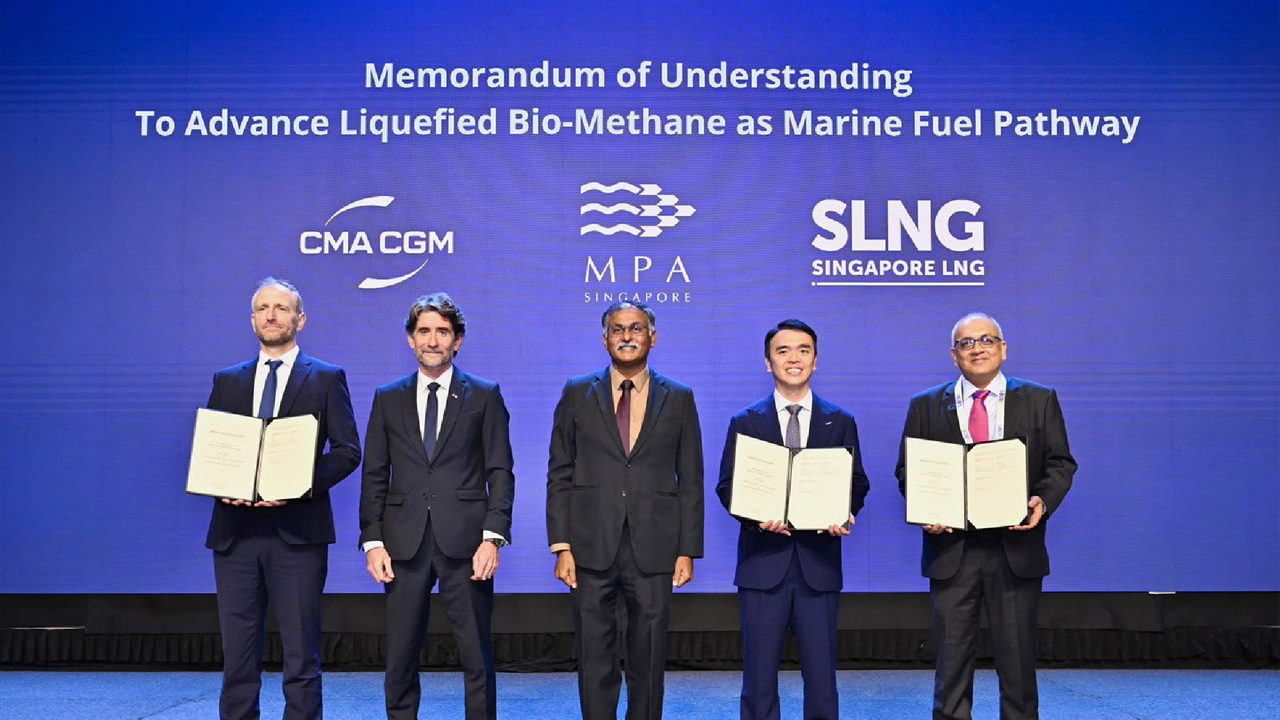
Building on established LNG infrastructure for lower-emission fuels
The Maritime and Port Authority of Singapore (MPA), the CMA CGM Group, and Singapore LNG Corporation Pte Ltd (SLNG) have signed a Memorandum of Understanding (MOU) to explore the supply and use of liquefied bio-methane as a marine fuel in Singapore.
The collaboration unites MPA's regulatory and industry development experience, CMA CGM's global shipping and logistics expertise, and SLNG's LNG terminal infrastructure and technical capabilities. Together, the three parties will exchange knowledge and industry best practices to support the development of liquefied bio-methane supply pathways in Singapore, covering fuel certification, physical supply, and maritime bunkering deployment.
• Mr Bo Wegener, Chief Executive Officer, CMA CGM, Asia Pacific
• Mr Leong Wei Hung, Chief Executive Officer, Singapore LNG Corporation Pte Ltd (SLNG)
Shared infrastructure, GHG accounting and operational pilots
A central focus of the MOU is evaluating how Singapore's existing gas and LNG infrastructure can be utilised to supply liquefied bio-methane for maritime operations. The partners will examine how the fuel's sustainability attributes and greenhouse gas (GHG) emission savings can be accurately tracked and accounted for when liquefied bio-methane is co-mingled with conventional natural gas in shared terminal and pipeline infrastructure.
To move from framework design to real-world deployment, MPA, CMA CGM, and SLNG will conduct operational pilots and trials to validate these accounting and supply approaches under live operating conditions. Findings from the trials will inform wider commercial application and build the technical foundation for liquefied bio-methane bunkering in Singapore.
| Partner Organisation | Core Domain | Strategic Contribution to the MOU |
|---|---|---|
| MPA Singapore | Maritime Regulator & Port Planner | Provides regulatory oversight, multi-fuel bunkering standards development, and industry coordination across Singapore's bunkering ecosystem. |
| CMA CGM Group | Global Shipping & Logistics | Brings operational shipping demand, fleet bunkering experience across 700+ vessels, and practical alignment with international maritime decarbonisation rules. |
| Singapore LNG (SLNG) | LNG Terminal Infrastructure | Contributes ISCC EU-certified terminal handling capabilities, storage and reload assets, and technical gas infrastructure expertise. |
Leadership perspectives on bio-methane adoption
"LNG is an established marine fuel in Singapore. We are now looking at how lower-emission variants can build on the infrastructure and capabilities already in place. This partnership will help us explore how we can support the supply and use of liquefied bio-methane as a lower-emission marine fuel, as we continue to build Singapore's multi-fuel bunkering capabilities."Mr Ang Wee Keong — Chief Executive, Maritime and Port Authority of Singapore (MPA)
"The decarbonisation of shipping requires collective action across the entire maritime ecosystem, underpinned by credible energy pathways that can be deployed at scale. Developing supply solutions for liquefied bio-methane for shipping is a key enabler to decarbonise the sector, in line with international environmental rules. Through this partnership, MPA, CMA CGM and SLNG will be bringing together our respective expertise to move ambition towards practical application."Mr Bo Wegener — Chief Executive Officer, CMA CGM, Asia Pacific
"Bio-methane is an important pathway to support both maritime decarbonisation and Singapore's broader energy transition efforts. As one of the first LNG terminals in the region to be certified under the International Sustainability and Carbon Certification EU (ISCC EU) framework to handle liquefied bio-methane, SLNG is well positioned to leverage our infrastructure and technical expertise to support its development. We are happy to be contributing to this collaboration with MPA and CMA CGM to strengthen the maritime industry's confidence in liquefied bio-methane, and encourage its adoption. This partnership highlights how existing LNG and gas infrastructure can continue to play a meaningful role, as the industry moves towards a lower-carbon future."Mr Leong Wei Hung — Chief Executive Officer, Singapore LNG Corporation (SLNG)
About the Maritime and Port Authority of Singapore (MPA): MPA was established in 1996 with the mission to develop Singapore as a global hub port and international maritime centre, and to advance and safeguard Singapore's strategic maritime interests. MPA takes on multiple roles as Singapore's maritime and port regulator and planner, international maritime centre champion, national maritime representative, and champion of maritime digitalisation and decarbonisation efforts. MPA partners industry, research community and other agencies to enhance safety, security and environmental protection, facilitate maritime and port operations and growth, expand multi-domain capabilities, and support the cluster of maritime services and manpower development. For more information, visit www.mpa.gov.sg.
About the CMA CGM Group: Present in 184 countries and employing 170,000 people, the CMA CGM Group is the world's third-largest shipping company, serving more than 420 ports across five continents with a fleet of over 700 vessels. In 2025, CMA CGM carried more than 24 million TEUs, while its subsidiary CEVA Logistics operates 1,000 warehouses and handled 15 million shipments. Committed to the energy transition, the CMA CGM Group aims for Net Zero Carbon by 2050. Find out more at cmacgm-group.com.
About Singapore LNG Corporation (SLNG): SLNG built, owns and operates Singapore's and Asia's first open-access, multi-user LNG terminal, and is developing Singapore's second LNG terminal. Beyond domestic throughput services, SLNG offers vessel gassing-up and cool-down, storage and reload (including small-scale LNG), LNG bunkering, transhipment, and truck loading to catalyse sustainable energy developments. For more information, visit www.slng.com.sg.