

No Silver Bullet: What the 10th Clean Marine Fuel Forum Told Us About the Future of Maritime Decarbonisation
From Singapore on 22 September 2026, a full-day forum brought together shipowners, fuel suppliers, class societies, regulators and financiers to reckon honestly with a question the industry can no longer defer: how does decarbonisation actually work at commercial scale?

The Industry Has Stopped Asking “If.” Now It Is Asking “How.”
The 10th edition of the Clean Marine Fuel Forum (CMFF 2026) was not a debate about whether the shipping industry needs to decarbonise. That question has been settled. What filled the rooms of the Concorde Hotel in Singapore on 22 September 2026 was something harder: the question of how to make decarbonisation work commercially and operationally at scale, in a world where the regulatory environment is fragmented, fuel economics are uncertain, and decisions taken today will define vessel operations well into the 2040s.
The forum, now in its tenth year, has become a reliable barometer of where the maritime fuel transition actually stands — not where it aspires to be. And if the 2026 edition had one clear conclusion, it was this: there is no magic fuel, and there is no single path forward. Progress will come from combining energy efficiency, fuel optionality, vessel readiness, infrastructure development, credible certification and regulatory clarity — not from betting the fleet on any one technology.
Singapore's own multi-fuel approach reflects this reality. Rather than declaring a winner, the Maritime and Port Authority of Singapore (MPA) is advancing methanol, LNG, ethanol, ammonia and biofuels simultaneously, anchored by ten Green and Digital Shipping Corridors (GDSCs) designed to turn ambition into real infrastructure and commercial practice.
Opening Dialogue: The 3A Framework
The forum opened with a dialogue between Conference Patron H.E. Leif Trana, Ambassador of Norway to Singapore, and Mr. Ang Wee Keong, Chief Executive of the MPA. The tone they set was one of pragmatism over optimism — acknowledging genuine uncertainty while arguing this uncertainty is a reason to move forward, not wait.
Ambassador Trana noted that despite macroeconomic turbulence and geopolitical friction, the broader maritime economy has proved more resilient than expected. For shipping, he argued, this resilience comes from diversification and flexibility — the same qualities the industry needs to apply to its fuel decisions.
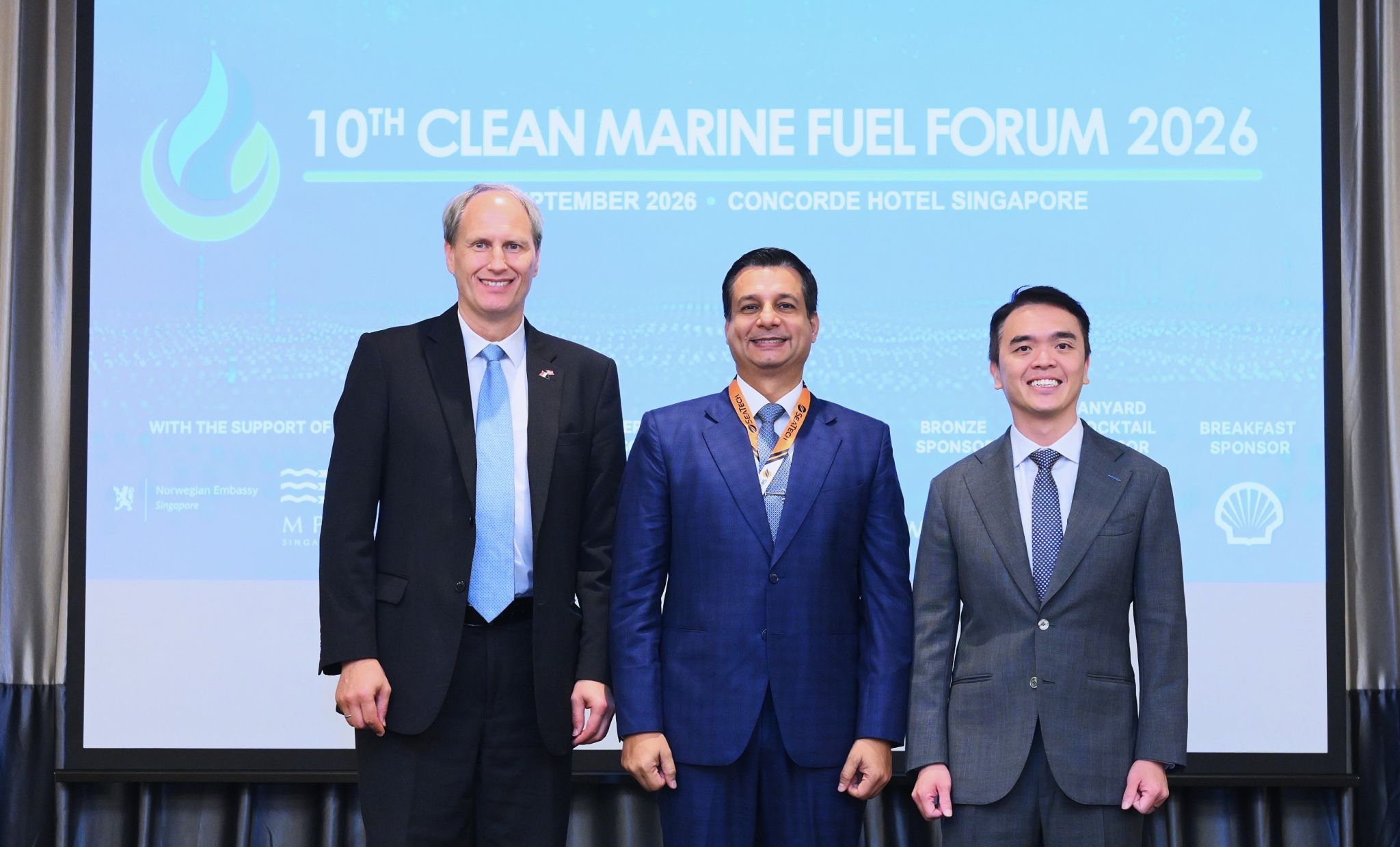
Mr. Ang Wee Keong framed the challenge through what he called the 3A Framework: for any alternative fuel to achieve commercial adoption, it must be Acceptable (safe, certified, compliant), Available (supply chain, bunkering, infrastructure) and Affordable (competitive on a total-cost basis). It sounds simple — but in practice it is brutally demanding, and it explains why, despite enormous investment and genuine enthusiasm, the maritime energy transition remains slow at scale. Several fuels tick one or two of the boxes. Very few currently tick all three.
“Alternative fuels ultimately need to be acceptable, available and affordable. A fuel can be technically viable, but if it falls short on the 3A’s, achieving adoption at scale would be significantly harder.”Mr. Ang Wee Keong — Chief Executive, Maritime and Port Authority of Singapore
The Keynote That Grounded the Room
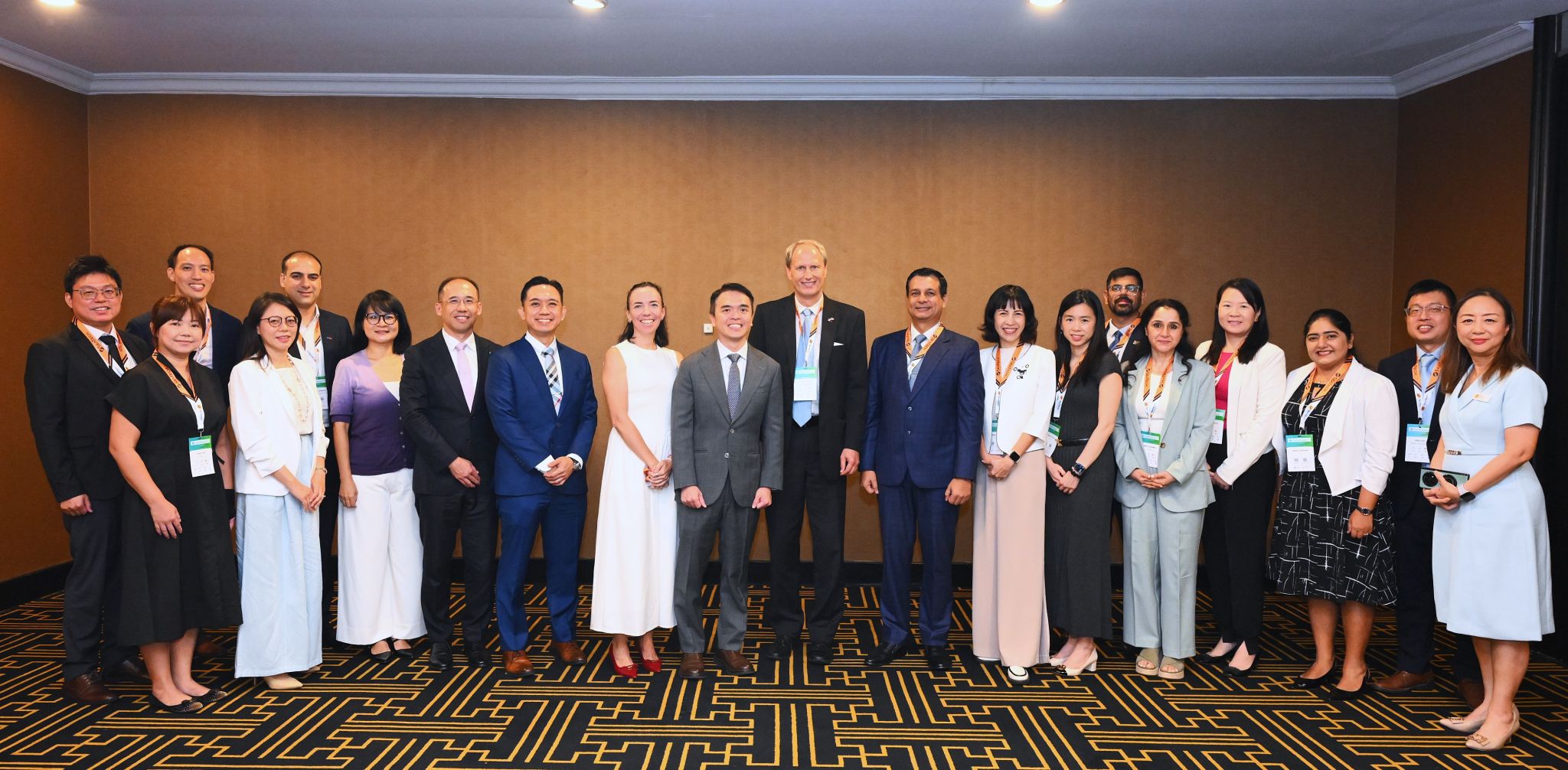
If there was a single presentation that brought the commercial reality of decarbonisation into sharpest focus, it was the featured address by Mr. Laurence Odfjell, Chair of Odfjell SE. His central argument was not about fuel choice — it was about financial survival across shipping cycles. Shipping is deeply cyclical. Any decarbonisation strategy that only works in a bull market is not a strategy; it is a gamble.
With that framing, he outlined Odfjell's three-pillar approach to the transition:
- Energy efficiency first. Around US$40 million has been invested in fleet efficiency, generating approximately US$27 million in annual savings. Fleet carbon intensity sits approximately 54% below the IMO Annual Efficiency Ratio benchmark, with a 57% reduction targeted by 2030.
- Fuel flexibility as a hedge. Rather than locking vessels into a single fuel ecosystem, Odfjell designs for optionality — dual-fuel capability and a preference for fuels that can evolve without fundamental redesign.
- Sustainable biofuels as a bridge. Working within existing infrastructure, the company has deployed B24 biofuel blends across its Brazil–Europe corridor with Petrobras, and tested B100 pure biofuel on the Bow Olympus combined with suction-sail wind propulsion.
The Odfjell story reinforced a theme that echoed throughout the day: efficiency is not a consolation prize for companies not ready to commit to new fuels. It is arguably the most commercially robust decarbonisation investment available today — delivering returns across all regulatory scenarios, requiring no new infrastructure, and needing no prediction of the future fuel mix.
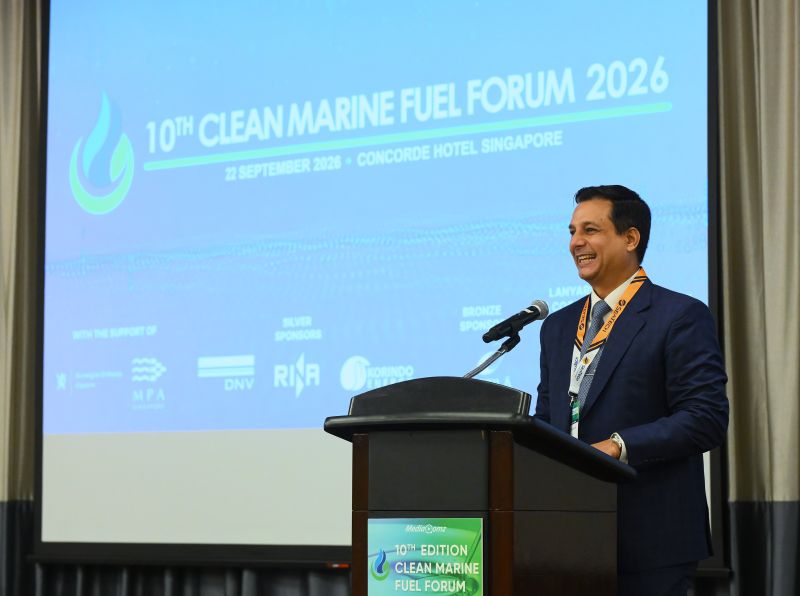
“The challenge is not technology. The biggest challenge today is execution.”Dr. Saunak Rai — Forum Chairman, 10th Clean Marine Fuel Forum 2026
Session 1: Fragmented Policies, Divergent Realities
The first panel confronted a structural problem: the various pieces of the maritime decarbonisation puzzle — regulation, investment, technology, infrastructure and workforce capability — are not developing at the same pace. And shipowners in the middle of this are expected to make capital commitments that span three decades.

Rohit Radhakrishnan opened with fleet data that illustrated the divergent pace of each pathway: around 55 LNG-fuelled vessels and 38 methanol-fuelled vessels have been delivered, with more than 300 methanol-fuelled vessels on order through 2030. Ammonia remains at an earlier stage, with just four vessels delivered. Each pathway is maturing on a different timeline, requiring different operational expertise and different infrastructure investment.
The Seafarer Competency Gap
Capt. Raymond Peter of Bernhard Schulte Shipmanagement made what was arguably the session's most striking point: the skills crisis runs parallel to the fuel diversity crisis. As fleets transition to LNG, methanol and ammonia, the demands placed on chief engineers and crews are escalating rapidly. Each fuel system has distinct safety protocols, toxicity profiles and emergency procedures — yet crew complements remain largely unchanged.
“The fragmentation today is not just on fuel availability, but also in the availability of people who can manage the fuels on board. There’s no single fuel winner.”Capt. Raymond Peter — Bernhard Schulte Shipmanagement (BSM)
Capt. Rahul Choudhuri of VPS addressed how fuel standards and quality assurance must evolve in step with the fuels themselves — drawing a telling comparison between LNG, which took decades to develop its standards infrastructure, and biofuels, which have scaled dramatically in a matter of years, sometimes outpacing the quality verification systems needed to support them.
The session closed with three near-term priorities: improving the efficiency of existing vessels, strengthening the application of fuel standards, and preserving optionality as new fuels develop. The overarching conclusion was clear: the challenge is not a shortage of possible solutions — it is getting all the necessary elements to develop together, in the right sequence.
Session 2: Fuel Availability vs. Vessel Readiness
The second session tackled one of the defining tensions in maritime decarbonisation: the gap between what fuels exist in theory and what can actually be reliably delivered to a vessel at the point of need, at the right cost, with the right certification.

Mark-Brian Nicdao of Shell made the case for LNG as a proven infrastructure platform — over 200 bunkering locations globally, 60–70 dedicated LNG bunker vessels, and a fleet that can transition towards bioLNG and synthetic LNG as those molecules become commercially available.
Choong Sheen Mao of Equatorial Marine Fuel Management brought a compliance economics lens: under mechanisms like the EU ETS and FuelEU Maritime, bunker selection is no longer driven purely by the price per tonne. Compliance cost, emissions intensity and regulatory treatment are all part of the equation — and they favour lower-carbon alternatives in ways that simple calorific-value comparisons do not.
Seshadri Gopalakrishnan of Bureau Veritas presented striking analysis: a 15-year total cost of ownership model for a Brazil–China bulk carrier showed ethanol — often overlooked in discussions dominated by methanol and ammonia — with the lowest modelled TCO under the assumptions used.
Andrew Hoare of Fortescue focused on green ammonia and what may be the decade's most consequential commercial question: who gets the environmental benefit when a vessel burns a zero-carbon fuel? The remaining challenge is not building supply chains alone — it is developing credible systems for measuring, pricing and allocating emissions attributes through mechanisms like book-and-claim and sustainability certification.
“Availability means more than just purely readiness. For alternative fuels to scale, the molecule, the vessel, the infrastructure and the business case must meet together.”Andrew Hoare — Fortescue
A live audience poll revealed that delegates overwhelmingly identified regulatory ambiguity as the primary barrier to long-term alternative fuel commitments — ahead of cost, financing and infrastructure. In open responses, nuclear propulsion surfaced as a technology several delegates flagged as worth serious attention for the 2040 horizon.
Session 3: From Pilots to Scale — What Will Actually Deliver?
The final session addressed a maturity challenge: the industry has accumulated an impressive portfolio of pilots and proof-of-concept projects. What it needs now are solutions that can move from the experimental to the repeatable — commercially viable at scale, not just technically feasible in controlled conditions.

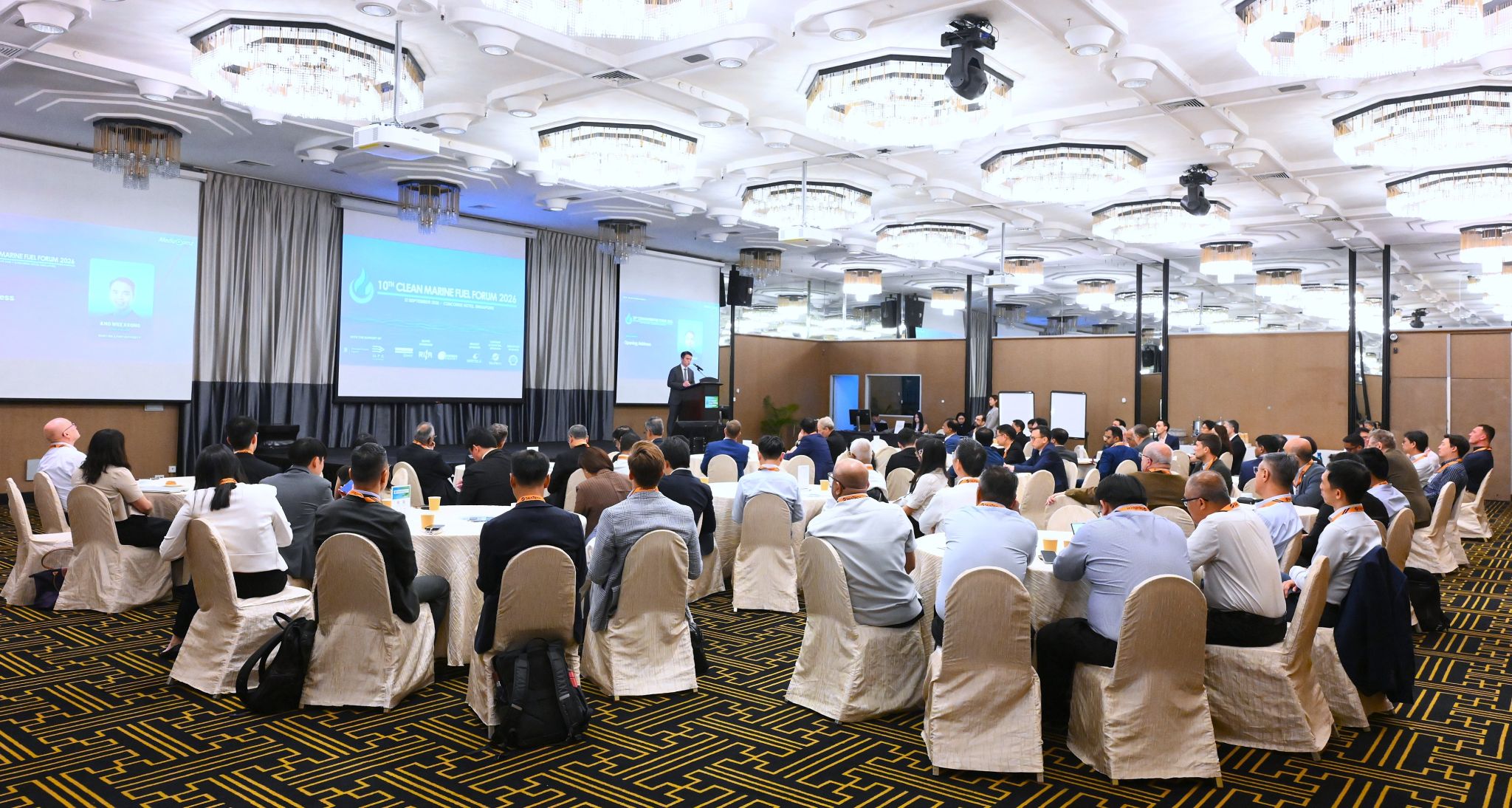
He Yi Yong of Straits Bio-LNG opened with an uncomfortable truth: Southeast Asia's biomass potential is enormous, but only 2–3% of regional palm-waste potential is currently monetised. The bottleneck is not regulation or engine compatibility — it is the aggregation infrastructure needed to turn dispersed waste streams into commercially meaningful volumes of biomethane.
Ashish Anilan of ITOCHU outlined three consecutive joint industry studies (2021–2024) on vessel safety, ammonia bunkering, fuel specifications and simultaneous operations including HAZID and dispersion modelling. Several years of careful groundwork are now feeding into an integrated deployment framework — but commercial ammonia bunkering still requires defined port safety perimeters and robust risk quantification.
Chris Chatterton made an optimistic case for retrofits: alcohol-capable vessels could exceed 1,200 ships by 2030, creating 10–12 million tonnes of annual fuel demand. Retrofitting existing engines represents a lower-CAPEX, faster route than waiting for scarce newbuild berths — and crucially, it decarbonises the fleet already at sea, not just the ships yet to be built.
Dr. Piyush Raj of DNV closed with a regulatory reality check: alternative-fuel vessel designs are advancing faster than the statutory IMO codes that govern them. Moving to scale safely requires stronger design requirements, clearer operating procedures, formal risk management frameworks and standardised crew competency programmes.
The Debates That Defined the Day
Beyond the formal panel sessions, several strategic debates ran as threads through the entire forum — representing the genuine fault lines along which the industry must make decisions in the years ahead.
| Debate | The Tension | Where CMFF 2026 Landed |
|---|---|---|
| Single fuel vs. multi-pathway | Some fuels offer stronger long-term emissions performance; others have established infrastructure today. | Preserve optionality while economics and regulatory frameworks develop. No single fuel can be selected with confidence. |
| Efficiency vs. fuel substitution | Fuel substitution gets most attention, but efficiency reduces cost and emissions without predicting the future fuel mix. | Focus first on consuming less energy — efficiency delivers returns across all regulatory scenarios. |
| Supply push vs. demand pull | Producers need demand before building supply. Buyers need supply before committing to demand. | Green Shipping Corridors and long-term offtake agreements are the mechanism to break this deadlock. |
| Physical fuel vs. book-and-claim | Should every vessel physically burn the fuel it claims credit for, or can environmental attributes be separated from the molecule? | Book-and-claim can unlock demand across fragmented markets — but only if standards are robust and double-counting is credibly prevented. |
| Newbuilds vs. retrofits | Newbuilds optimise the whole vessel for a new fuel. Retrofits are faster, cheaper — and decarbonise the fleet that already exists. | Both are necessary. Retrofit solutions for methanol, ethanol and biofuels deserve significantly more attention than they currently receive. |
Eight Things the Industry Needs to Act On
Across three sessions and a full day of discussion, a set of concrete findings emerged that should inform boardroom decisions across shipping companies, fuel suppliers, financiers and port authorities over the next five years.
Conclusion: The Conversation Has Grown Up
Reflecting on CMFF 2026 against the nine editions that preceded it, the most significant shift is not in the technologies being discussed — it is in the nature of the questions being asked. Early editions were largely about possibility: could alternative fuels work for shipping? That question has been substantially answered. The more demanding questions now concern execution.

There may be no single magic fuel. The eventual maritime energy mix is unlikely to be uniform. But what appears increasingly clear, as the 10th edition of CMFF demonstrated, is the value of efficiency, flexibility and optionality while the industry works towards longer-term solutions.
The most successful pathways in the years ahead may not be those that attempt to predict the future perfectly — but those capable of progressing today without closing off tomorrow's options.
For a forum marking its tenth edition, that is perhaps the clearest indication of how much the conversation has matured: from asking what the future fuel will be, to determining how the industry can build the conditions for decarbonisation at scale. The next decade will be less about identifying possibilities, and more about delivering them.